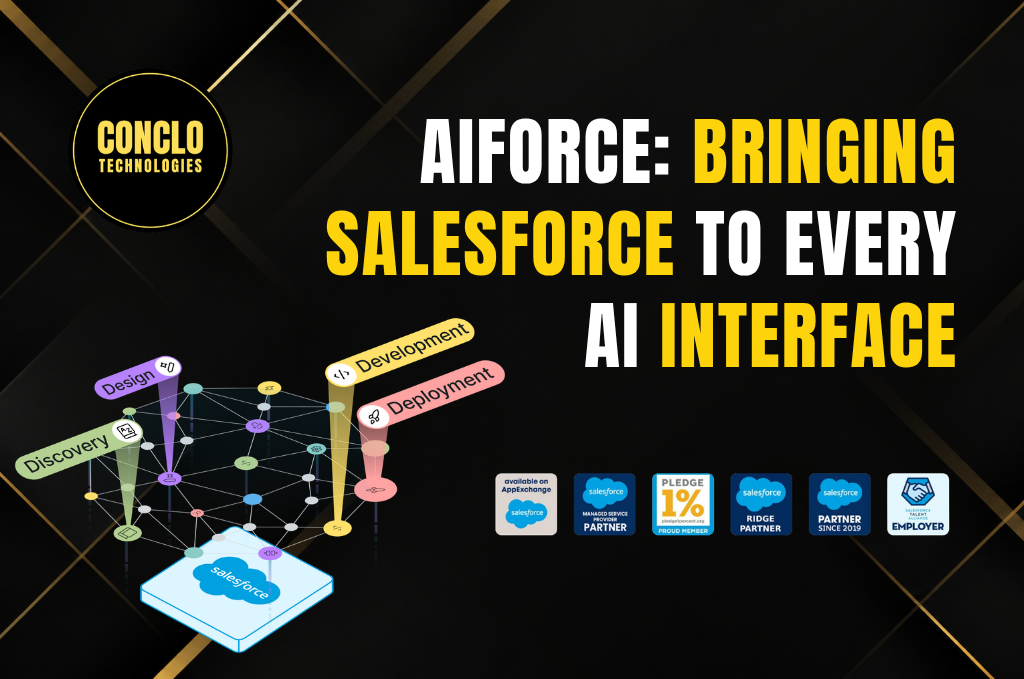

Business teams rely on Salesforce to manage customer relationships, but important work often happens elsewhere, in messaging platforms, AI assistants, and collaborative applications. Salesforce AIforce addresses this disconnect by making CRM data and business capabilities available within the interfaces employees already use. Introduced at Dreamforce 2026, this live interface layer signals a shift from navigating software screens to completing work through trusted, context-aware AI experiences.
Salesforce CRM, Wherever Work Happens
Traditional CRM workflows involve opening Salesforce, locating records, and moving between screens to complete tasks. AIforce changes the starting point. Employees can ask questions, retrieve customer insights, update information, or initiate approved workflows from supported AI interfaces such as Claude and Slack.
Rather than replacing Salesforce, AIforce brings its existing capabilities into these environments. Teams can interact with business information through natural language and generate tailored, interactive views suited to their immediate needs. For sales and service teams, this could mean less application switching and faster access to relevant customer context.
For example, an account executive could request a summary of support cases before a renewal meeting, then use an authorized workflow to assign follow-up tasks without manually gathering information across screens.
One Trusted Foundation for Every AI Experience
AIforce builds on Salesforce’s Agentic Enterprise architecture. Data 360 provides unified data and context, while Customer 360 supplies the application logic, customer processes, and permissions behind enterprise CRM operations. Agentforce adds AI agents that can reason and execute assigned tasks. AIforce connects these components to the interface where work takes place.
The underlying Headless Toolkit gives developers access to Salesforce capabilities through Model Context Protocol (MCP), APIs, plugins, skills, and other developer tools. This headless approach separates business functionality from a fixed user interface, allowing organizations to build experiences without recreating their core CRM logic. For Salesforce architects, this also means established automation, business semantics, and security policies can remain central as new AI experiences emerge.
Key AIforce Experiences and Capabilities
Salesforce is introducing multiple ways for employees, developers, and AI agents to use the same trusted foundation:
- Claudeforce: Connects Salesforce to Anthropic’s Claude through a prebuilt MCP server, with 37 sales skills supporting activities such as prospecting and pipeline management.
- Slackforce: Brings Salesforce context into Slack conversations. Interactive Surfaces let teams explore information and collaborate on actions together.
- Agentforce Coworker: Works within Salesforce Lightning, using account records, activity, and history to answer questions and coordinate actions through existing agents.
- Headless Toolkit: Enables custom AI applications and interfaces with Salesforce APIs, MCP servers, and reusable development tools.
- Dynamic Interfaces: Let users describe the information or workflow they need and create contextual views without relying solely on fixed dashboards.
According to Salesforce’s Dreamforce 2026 updates, Agentforce Coworker is generally available, Claudeforce is in beta, and Slackforce was scheduled for general availability in October. Availability and licensing should be confirmed for each organization.
Security, Governance, and Real Business Value
Enterprise AI must respect the same safeguards as traditional software. Salesforce says AIforce uses existing identity permissions and business rules so agents operate within a user’s authorized access. Actions route through Salesforce, and the architecture includes zero data retention protections for model-provider processing. Organizations should still validate their configurations, integrations, audit requirements, and approval steps.
The business opportunity is practical: accelerate account research, simplify CRM updates, coordinate service responses, and reduce repetitive navigation. Successful implementation begins with a high-value use case, clear performance measures, and testing against real workflows. Teams should assess data quality, access controls, agent behavior, and employee adoption before scaling.
For organizations working with a Salesforce Crest Partner, AIforce creates an opportunity to extend existing CRM investments into everyday collaboration tools. The long-term value is not another AI interface, but consistent, secure access to actionable customer intelligence wherever employees choose to work.