
Salesforce is moving beyond traditional CRM and basic AI assistants toward an agentic AI model where agents understand business context, reason through requests, use tools, and complete work across systems. Model Context Protocol, or MCP, is becoming important because it gives AI applications a standardized way to connect with external tools, data, and services. Salesforce has built an MCP client into Agentforce, helping organizations extend agent capabilities beyond Salesforce while maintaining governance and security.
From AI Assistants to AI Agents
Salesforce AI is moving beyond simple question and answer experiences. Traditional assistants mainly provide information, while AI agents can understand context, make decisions, select tools, and complete actions. An Agentforce agent may need to check inventory, retrieve an order from an ERP system, verify payment status, access an external API, or trigger a business process. This makes AI more valuable because agents can move from suggesting answers to completing work.
For Salesforce teams, this changes solution design. Agents require secure access to business capabilities across the organization. Building separate integrations for every agent and external system can become complex to maintain. MCP offers a more consistent approach.
MCP Becomes the Connectivity Layer
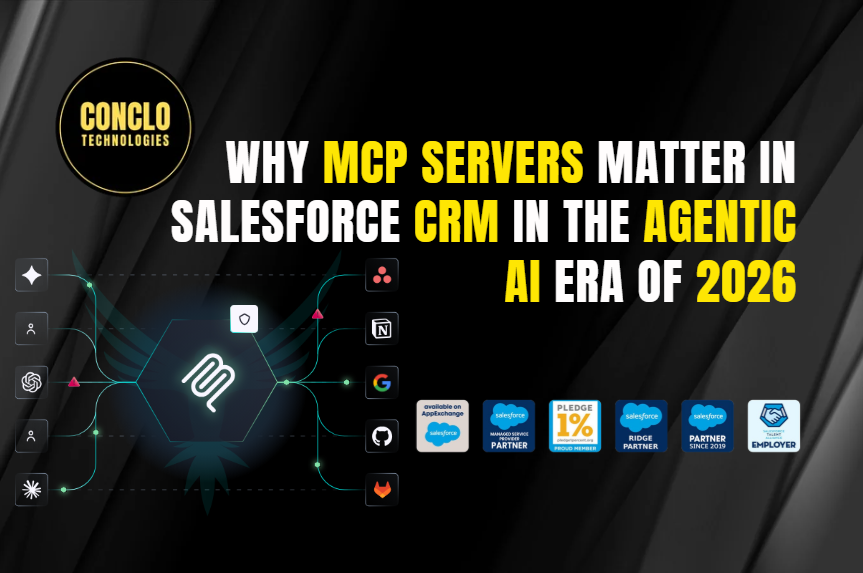
Model Context Protocol provides a standardized approach for connecting AI applications and agents with external tools, resources, and systems. An MCP server can expose reusable capabilities that an AI agent can discover and call when needed. Salesforce supports Agentforce as an MCP host and client, connecting agents to one or more MCP servers and their tools.
Consider a customer service scenario. An Agentforce agent can read a Case in Salesforce, call an MCP tool to check an order in an ERP platform, retrieve shipping information, and use the result during the customer interaction. Instead of creating tightly coupled integrations for every external function, organizations can expose reusable capabilities through MCP servers and share them across agents. Salesforce describes this model as a way to extend Agentforce with third party tools and services.
The Future: Salesforce + Agents + MCP
The future of Salesforce architecture is increasingly becoming CRM + AI + Agents + MCP + enterprise systems. Salesforce provides customer and business context, while Agentforce provides reasoning, orchestration, and tool usage. MCP acts as a standardized bridge between Salesforce agents and external enterprise capabilities.
- Connected Architecture: Salesforce, Agentforce, MCP, and enterprise systems can work together to create a more connected and intelligent CRM ecosystem.
- Reusable Capabilities: MCP allows organizations to expose external tools and services that can be reused across multiple Agentforce agents instead of building separate integrations for every use case.
- Enterprise Connectivity: Agents can connect with systems such as ERP, payments, inventory, logistics, analytics, and external APIs, extending capabilities beyond Salesforce.
- Better Scalability: Developers and architects can build reusable agentic applications by separating agent logic from external system capabilities.
- Centralized Governance: Salesforce supports registering third party MCP servers through Agentforce Registry, while Salesforce and MuleSoft hosted MCP servers can be managed through API Catalog.
- The Bigger Opportunity: MCP can help Salesforce evolve from a system of record into a platform where AI agents securely access information, use tools, and take meaningful actions across the enterprise.
Why MCP Matters for Salesforce CRM
For businesses investing in Salesforce Agentforce, MCP can extend AI beyond Salesforce data and allow agents to participate in broader enterprise workflows. This can reduce integration complexity and make new capabilities easier to introduce.
Governance is especially important as AI agents gain access to business systems. Salesforce provides capabilities to register MCP servers, allowlist tools, assess risks, and apply policies that govern MCP usage. This gives organizations greater control over agent access to external tools.
For Salesforce professionals, understanding MCP is not simply about learning another integration technology. It is about preparing for a connected agentic AI future where Salesforce agents can securely access the capabilities they need and take meaningful action across the enterprise. As Agentforce evolves, MCP can become a foundation for building intelligent, scalable, reusable, and governed Salesforce solutions.